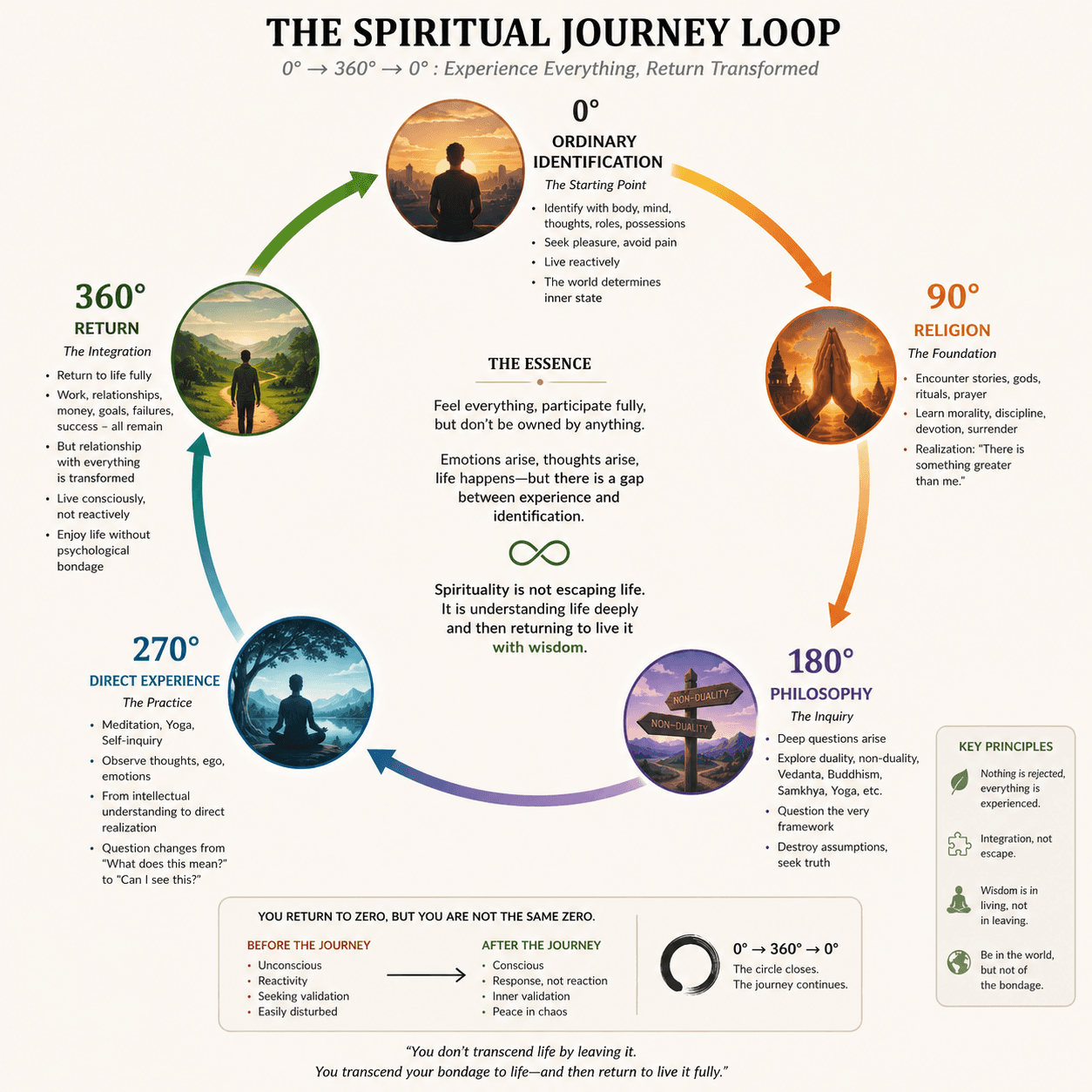
The Spiritual Journey: From Zero to Zero
The Spiritual Journey: From Zero to Zero
0° → 360° → 0° — Experience Everything, Return Transformed
There is a way of looking at spirituality that I find deeply fascinating.
Perhaps the purpose of a spiritual journey is not to permanently leave the world behind.
Perhaps it is to understand the world—and ourselves—so deeply that we can eventually return to ordinary life without being psychologically enslaved by it.
In that sense, spirituality is not necessarily a straight line.
It is a circle.
0° → 360° → 0°
You begin at zero.
You travel through religion, philosophy, meditation, self-inquiry and direct experience. You question almost everything you previously believed. And eventually, you return to the same ordinary life you started with.
You still work.
You still have relationships.
You still experience pleasure and pain.
You still pursue goals.
But something fundamental has changed.
You are no longer relating to life in quite the same way.
0° — The Starting Point: Ordinary Identification
Every journey has to begin somewhere.
At the beginning, most of us experience life through identification.
“I am my body.”
“I am my thoughts.”
“I am my achievements.”
“I am what people think about me.”
“I need this to happen for me to be happy.”
“I must avoid that because it will make me suffer.”
This is not necessarily a moral failure. It is simply the ordinary human condition.
We experience events and immediately create psychological conclusions from them.
Someone praises us → we feel good.
Someone insults us → we feel bad.
We succeed → our self-image expands.
We fail → our self-image contracts.
Something we love comes closer → attachment arises.
Something we fear approaches → resistance arises.
Life happens, and our inner state constantly moves with it.
At this stage, we don't merely experience life.
We are psychologically entangled with it.
And this is where the journey begins.
90° — Religion: The Foundation
The next step for many people is religion.
Religion introduces something larger than the individual ego.
God.
Dharma.
Karma.
Devotion.
Prayer.
Ritual.
Stories.
Mythology.
Moral discipline.
The Ramayana, Mahabharata, Puranic stories, and countless traditions give the mind symbols through which it can begin to contemplate something beyond itself.
At this stage, spirituality often begins with a simple realization:
“There is something greater than me.”
Religion provides structure.
It teaches discipline before freedom, responsibility before transcendence, and often devotion before philosophical inquiry.
But eventually, for a genuinely curious mind, another question appears:
Is this literally true, or is there something deeper underneath the symbols?
And that question takes us further.
180° — Philosophy: The Inquiry
Religion can give you answers.
Philosophy teaches you to investigate the answers.
Now the questions become much more fundamental:
Who am I?
What is consciousness?
What is reality?
What is the self?
Why do I suffer?
What is God?
Is the individual actually separate from reality?
This is where the enormous philosophical landscape of Indian thought becomes fascinating.
You encounter different approaches to reality—dualism, qualified non-dualism, non-dualism, Samkhya, Yoga, Buddhism, Jain philosophy, and many other schools.
Within Vedanta itself, you encounter radically different interpretations of the relationship between Atman, Brahman and the world.
Advaita Vedanta takes the inquiry toward non-duality:
Atman is Brahman.
The apparent separation between the individual self and ultimate reality is investigated at its deepest level.
But philosophy has a limitation.
You can intellectually understand a concept without actually realizing it.
Knowing the definition of water does not quench thirst.
Knowing the word “non-duality” does not mean one has transcended the experience of separation.
And therefore the journey has to move from intellectual understanding to direct investigation.
270° — Direct Experience: Practice
This is where spirituality becomes experiential.
Meditation.
Yoga.
Self-inquiry.
Contemplation.
Mindfulness.
Devotion.
Silence.
Observation.
The specific practice may differ according to the tradition, but the underlying movement is similar:
Stop merely collecting ideas about reality and begin examining experience itself.
Instead of asking:
“What does this philosophy say about the mind?”
you begin asking:
“What is actually happening in my mind right now?”
Instead of merely hearing:
“You are not your thoughts,”
you observe thoughts arising and disappearing.
Instead of intellectually accepting:
“The ego is constructed,”
you begin examining how the sense of “I” is continuously created through memory, thought, desire and identification.
This is where the distinction between experience and identification becomes extremely important.
A thought can arise without being obeyed.
An emotion can arise without becoming an identity.
Fear can arise without completely controlling behaviour.
Anger can arise without turning into unconscious action.
Pain can exist without automatically becoming psychological suffering.
The goal is not necessarily to eliminate experience.
It is to understand our relationship with experience.
360° — The Return
And then comes the most interesting part.
You return.
Back to life.
Back to ordinary existence.
This is why I call the journey a circle rather than a ladder.
You don't necessarily finish spirituality by permanently sitting in a cave somewhere.
You come back.
You work.
You study.
You build things.
You earn money.
You fall in love.
You make mistakes.
You laugh with your friends.
You experience success.
You experience failure.
You deal with annoying people.
You pay bills.
You wake up on Monday morning.
Life continues.
But perhaps the difference is that you no longer require life to constantly obey your psychological preferences.
You can enjoy pleasure without desperately clinging to it.
You can experience failure without concluding that you are a failure.
You can experience criticism without immediately collapsing into defensiveness.
You can experience anger without becoming anger.
You can experience uncertainty without demanding immediate certainty.
You can love without confusing love with possession.
You can pursue ambition without making achievement the foundation of your identity.
This is not emotional numbness.
Quite the opposite.
It may mean experiencing life more completely, because less energy is being spent fighting reality internally.
The Paradox: You Return to Zero, But You Are Not the Same Zero
This is the central idea of the entire model.
Before the journey:
0° — Unconscious identification
After the journey:
360° — Conscious participation
Externally, the two lives might look remarkably similar.
Internally, the relationship with life can be radically different.
Before:
“What happens determines how I feel.”
After:
“What happens is experienced, understood and responded to—but it does not completely determine who I am.”
Before:
Reaction.
After:
Response.
Before:
Attachment.
After:
Participation without psychological bondage.
Before:
Seeking something outside myself to complete myself.
After:
Living without requiring every external condition to complete me.
That is why the circle is so interesting.
You return to where you started, but you don't return as the same person.
The Goal Is Not to Become Emotionless
There is another important distinction.
Spiritual maturity should not be confused with becoming emotionally dead.
If someone says:
“Nothing affects me anymore.”
that does not automatically mean enlightenment.
It could simply mean suppression, detachment in the unhealthy sense, or emotional numbness.
A deeper possibility is:
Feel everything. Identify with nothing unnecessarily.
Anger may arise.
Sadness may arise.
Fear may arise.
Joy may arise.
Love may arise.
Desire may arise.
But there is increasing awareness around these experiences.
The storm can exist without convincing you that you are the storm.
This is close to the spirit of witnessing consciousness found throughout Indian contemplative traditions: observing the movements of the mind without automatically confusing those movements with the deepest Self.
Spirituality Is Not Escaping Life
This is perhaps the biggest misunderstanding I would challenge.
If spirituality becomes an excuse to avoid life, responsibilities, relationships, ambition, uncertainty and suffering, something may have gone wrong.
The deeper question is not:
“How do I escape the world?”
It is:
“Can I participate completely in the world without being psychologically owned by it?”
This idea has a strong resonance with the Bhagavad Gita.
Krishna does not tell Arjuna simply to abandon action.
He teaches action without attachment to its fruits.
The battlefield becomes a profound metaphor for life itself:
Act. Participate. Fulfil your responsibility. But do not make your psychological existence completely dependent upon the outcome.
That is radically different from passivity.
It is not:
“I don't care.”
It is:
“I care deeply, but I am not destroyed when reality refuses to obey me.”
The Circle
So the journey can be represented simply:
0° — Ordinary Identification ↓ 90° — Religion ↓ 180° — Philosophy ↓ 270° — Direct Experience ↓ 360° — Return to Life ↓ 0° — Ordinary Life, Transformed Relationship
The circle closes.
But the journey doesn't really end.
Because now ordinary life itself becomes the practice.
Every relationship becomes an opportunity to observe attachment.
Every failure becomes an opportunity to observe the ego.
Every success becomes an opportunity to observe attachment to achievement.
Every difficult person becomes an opportunity to observe reaction.
Every moment of pleasure becomes an opportunity to observe craving.
Every moment of suffering becomes an opportunity to investigate identification.
The spiritual journey that once happened on a meditation cushion now happens in the middle of life itself.
The Essence
Perhaps the entire journey can be condensed into one sentence:
You don't transcend life by leaving it; you transcend your bondage to life—and then return to live it fully.
The highest point of the journey may therefore look surprisingly ordinary.
You don't necessarily become someone who floats above the world.
You become someone who can stand firmly inside it.
You experience everything.
You participate fully.
You love.
You build.
You lose.
You win.
You suffer.
You celebrate.
And through it all, there is an increasing understanding:
I can experience life without needing to be psychologically imprisoned by every experience.
And so the circle returns to zero.
Not because nothing was learned.
But because nothing outside the Self was ultimately required to complete the journey.
0° → 360° → 0°
The circle closes.
Life begins again.